Short answer: The 70% rule says the most you should pay for a house you plan to flip is 70% of its after-repair value (ARV), minus the cost of repairs. If a house will be worth $300,000 after a $40,000 renovation, your maximum offer is $300,000 × 70% − $40,000 = $170,000. The 30% cushion is meant to cover holding costs, closing and selling costs, and your profit.
House flipping looks simple on TV: buy it, fix it, sell it. In real life, most flips that lose money were bought for too much on day one. The 70% rule exists to stop that. It gives you a firm ceiling for your offer before emotion, a bidding war or an exciting design plan can push you past it. Here is how JW Martin Real Estate helps Upstate investors use it.

The 70% rule formula
Maximum allowable offer (MAO) = (ARV × 0.70) − repair costs
- ARV (after-repair value): what the home should sell for once it is fixed up, based on recent comparable sales.
- Repair costs: your full renovation budget, ideally with a contingency.
Worked example (hypothetical)
- ARV: $300,000
- 70% of ARV: $210,000
- Repairs: $40,000
- Maximum offer: $170,000
Where does the other $90,000 (30% of ARV) go?
- Buying closing costs and loan points
- Holding costs: interest, taxes, insurance and utilities for several months
- Selling costs: commission, closing costs and concessions
- Profit and a cushion for surprises
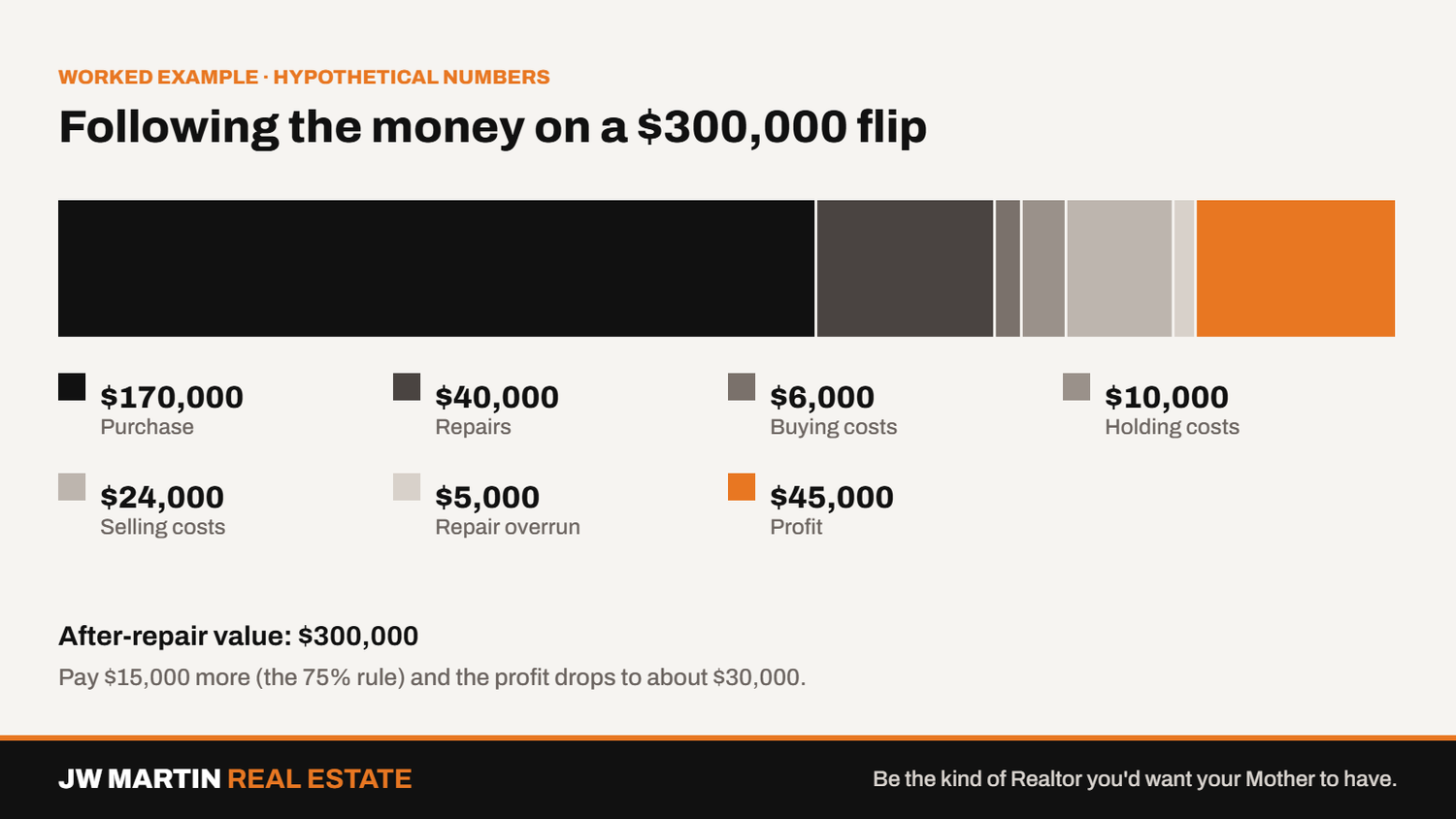
Following the money on a flip
Here is how that $90,000 cushion might actually get spent on the example above. All numbers are hypothetical.
- Buying closing costs and lender points: $6,000
- Holding costs for 5 months at about $2,000 a month: $10,000
- Selling costs (commission, seller closing costs and buyer concessions) at about 8%: $24,000
- Contingency actually used on repairs: $5,000
- Total costs beyond price and repairs: $45,000
Estimated profit: $300,000 − $170,000 − $40,000 − $45,000 = about $45,000 before taxes.
That is a healthy result, but notice how fast it could shrink. Two extra months of holding costs, a $15,000 surprise behind the walls, or a sale price $20,000 below your ARV would cut the profit by more than half.
Hypothetical numbers for illustration.
Test your deal in our fix-and-flip calculator.
70% vs. 75%: what a few points cost you
On the same house, some flippers stretch to the 75% rule:
- 75% of $300,000: $225,000
- Minus $40,000 repairs: maximum offer $185,000
- With the same $45,000 in costs, profit drops to about $30,000
Paying $15,000 more removes a third of the profit and most of your margin for error. That is why we suggest staying near 70% unless you have strong comps, a proven contractor and a fast-moving market.
When to adjust the 70%
- Lower-priced homes: fixed costs eat a bigger share of a small sale price. Many flippers use 65% or less.
- Heavy rehabs: more unknowns call for a lower percentage.
- Higher-priced homes or hot markets: some experienced flippers stretch toward 75%, accepting a thinner margin.
- Slow markets: longer days on market mean more holding costs, so be more conservative.
The two numbers that make or break a flip
1. ARV. Use recent, truly comparable sold homes, similar in size, age, condition and location. Lake access, school zones and lot features can swing value a lot in the Upstate. A home a mile from Lake Keowee and a home with a dock on it are not comparable, even if they look alike inside.
2. Repair budget. Walk the property with a contractor. Budget for what you can't see: plumbing, electrical, foundation, septic and permits. Add a 10% to 20% contingency.
A realistic flip timeline
- Weeks 1 to 2: close, pull permits, order materials.
- Weeks 2 to 10: demolition and renovation. Older homes often take longer.
- Weeks 10 to 12: final punch list, cleaning, staging and photos.
- Weeks 12 to 20: listing, showings, contract and closing.
Every month you add to this timeline is another month of interest, taxes, insurance and utilities.
Common flipping mistakes
- Overestimating ARV with "best case" comps.
- Underestimating repairs and timelines.
- Forgetting holding costs on a project that runs long.
- Overimproving for the neighborhood.
- Ignoring taxes. Flip profits are generally taxed as ordinary income, and frequent flippers may owe self-employment tax. Talk to a CPA.
Frequently asked questions
Does the 70% rule include closing costs? Not directly. The 30% cushion is meant to absorb closing, holding and selling costs plus profit. That's why accurate ARV and repair numbers matter so much.
Is the 70% rule too strict today? In competitive markets, some investors pay more, but every point above 70% cuts into your safety margin.
What ARV should I use in a fast-moving market? Use the last three to six months of truly comparable sales, and look at pending sales too. Do not assume prices will keep rising while you renovate.
Can I use the 70% rule for BRRRR? Many BRRRR investors use a similar test. See our BRRRR guide.
How JW Martin Real Estate helps flippers
JW Martin Real Estate is a locally owned, non-franchise brokerage. We live in the Upstate and see what buyers here are paying for, which finishes they expect, and which neighborhoods hold value. That local knowledge is what turns an ARV guess into an ARV you can trust.
Our team decisions have to pass the Mom Test: Is this a decision my Mother would be proud of? For flippers, that means honest comps on the way in and an accurate pricing strategy on the way out. When your flip is finished, we can list and market it with the same care we give every seller. See our listing process and remodeling ROI guide.
The bottom line
The 70% rule is a quick, disciplined way to keep your offers from getting ahead of the numbers. Pair it with honest comps, a real repair budget and a full profit analysis before you buy.
Talk with an Upstate investment specialist
Need help pulling comps for an ARV or finding fixer-uppers in the Upstate? Visit our Investor Resource Center, search properties, or call JW Martin Real Estate at (864) 722-5558. Already own rentals? JW Martin Property Management can help. As we like to say, "Be the kind of Realtor you'd want your Mother to have."
This article is general education, not financial, tax or legal advice. Examples are hypothetical and returns are not guaranteed.