Short answer: Cash-on-cash return measures the yearly pre-tax cash flow a rental puts in your pocket compared with the cash you invested. Invest $60,000 and earn $3,600 a year after every expense and the mortgage, and your cash-on-cash return is 6%. What counts as "good" depends on your goals, your risk and what else you could do with the money.
Of all the numbers investors track, cash-on-cash return is the one that answers the most practical question: how hard is my money working this year? It is simple to calculate, easy to compare and hard to fake, as long as you use honest numbers. This guide from JW Martin Real Estate explains the formula, walks through a full example, and shows how down payment, rates and expenses change the result.

The cash-on-cash formula
Cash-on-cash return = annual pre-tax cash flow ÷ total cash invested
- Annual pre-tax cash flow: rent minus all operating expenses minus your mortgage payments, for a year.
- Total cash invested: down payment + closing costs + repairs + any other cash you put in.
Worked example (hypothetical)
- Purchase price: $240,000
- Down payment (20%): $48,000
- Closing costs: $6,000
- Make-ready repairs: $6,000
- Total cash invested: $60,000
Yearly numbers, using an example 6.75% rate on a 30-year loan:
- Rent: $2,300 × 12 = $27,600
- Operating expenses (taxes, insurance, management, maintenance, vacancy, reserves): $9,600
- Net operating income: $18,000
- Mortgage payments on $192,000: about $14,944
- Cash flow: about $3,056 a year
Cash-on-cash: $3,056 ÷ $60,000 = about 5.1%
Plug in your own numbers in our rental cash-flow calculator.
How down payment changes the answer
Using the same property, here is what happens when you put in more cash:
- 20% down ($60,000 cash in): cash flow about $3,056, cash-on-cash about 5.1%
- 25% down ($72,000 cash in): cash flow about $3,990, cash-on-cash about 5.5%
- All cash ($252,000 cash in): cash flow $18,000, cash-on-cash about 7.1%
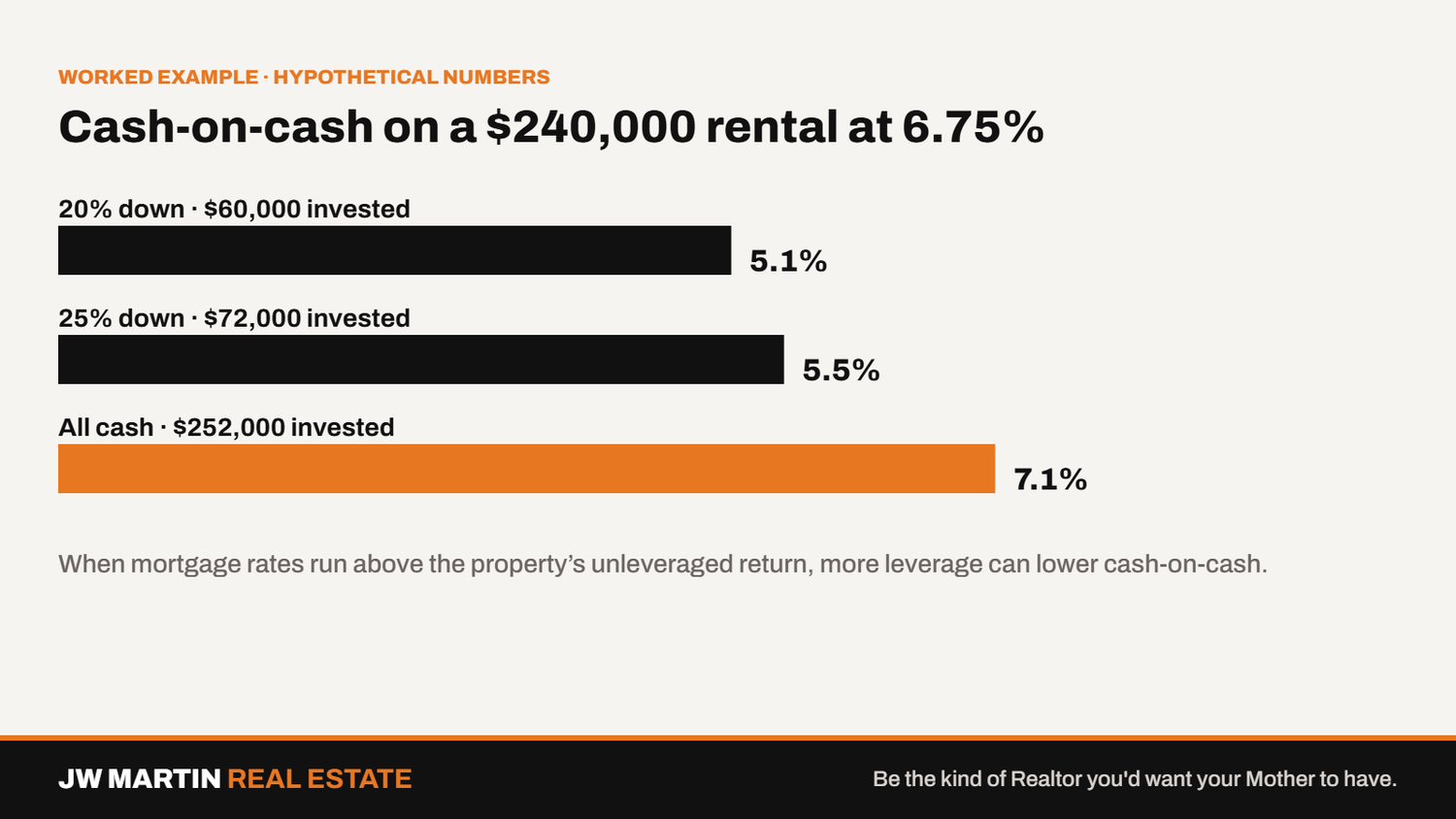
Hypothetical numbers for illustration.
That last line surprises people. When mortgage rates are higher than the property's return before financing, borrowing more can actually lower your cash-on-cash return. When rates are lower, leverage usually raises it. This is why we always suggest running more than one financing scenario before you decide how much to put down.
So what is a "good" cash-on-cash return?
There is no single right answer. Investors weigh:
- Your alternatives. What could the same cash earn elsewhere with similar risk?
- Risk. Older or lower-priced properties may show higher returns but come with more repairs and vacancy.
- Appreciation and loan paydown. A lower cash-on-cash return can still be a strong investment in an area with good long-term demand.
- Effort. Self-managing raises your return but costs your time.
Many investors look for a positive return that beats their other options after realistic expenses. Be wary of very high returns. They often come from underestimating expenses.
Looking past year-one cash flow
Cash-on-cash only counts the cash that hits your bank account. On the 20%-down example, the first year also includes:
- Principal paydown: about $2,000 of your payments reduce the loan balance.
- Appreciation: if the home gains even 3% in value, that is about $7,200 of added equity.
- Depreciation: residential rentals are generally depreciated over 27.5 years, which can reduce taxable income. Ask your CPA how it applies to you.
Add those together and the total first-year return can be much higher than 5.1%. That is why investors in growing areas like Clemson, Seneca, Greenville and the lake communities often accept modest cash-on-cash returns.
Cash-on-cash vs. cap rate vs. ROI
- Cap rate = NOI ÷ price. Ignores financing. Good for comparing properties.
- Cash-on-cash = cash flow ÷ cash invested. Includes financing. Good for comparing your actual deal.
- ROI = total gain ÷ cash invested, including appreciation and loan paydown, often measured over the whole hold.
- IRR adds timing, for comparing deals over many years.
What cash-on-cash leaves out
- Principal paydown on your loan
- Appreciation
- Tax benefits like depreciation (ask your CPA)
- Big future repairs if you didn't reserve for them
That's why many investors look at cash-on-cash alongside total return.
Common mistakes
- Leaving closing costs or repairs out of "cash invested."
- Using best-case rent and low expenses.
- Using the seller's tax bill. In South Carolina, rentals are assessed at 6% instead of the 4% primary-residence rate.
- Forgetting capital reserves.
- Comparing a leveraged deal's cash-on-cash to an all-cash deal's cap rate.
Frequently asked questions
Can cash-on-cash be negative? Yes, if the property loses money each year after the mortgage.
Does a bigger down payment raise cash-on-cash? Not always. It lowers your payment but raises your cash invested. Run both ways.
Do lenders look at cash-on-cash return? Most investment lenders focus on DSCR, which compares the property's income to the loan payment, rather than cash-on-cash. You can see both in our rental cash-flow calculator.
How does BRRRR affect cash-on-cash? Pulling cash out in a refinance shrinks your cash invested, which can raise the percentage even if dollar cash flow is small. See our BRRRR guide.
How JW Martin Real Estate helps you measure returns honestly
JW Martin Real Estate is a locally owned, non-franchise brokerage, and our team lives in the Upstate communities where our clients invest. Because we also operate JW Martin Property Management, we work with real rents, real repair bills and real vacancy every month.
Every decision our team makes has to pass the Mom Test: Is this a decision my Mother would be proud of? When we help you analyze a rental, that means conservative rent, the correct rental tax rate and full reserves, so the return you plan on is the return you are likely to see.
The bottom line
Cash-on-cash return is one of the clearest ways to see how hard your money is working. Use real expenses, count every dollar you put in, and weigh it alongside appreciation, risk and your long-term goals.
Talk with an Upstate investment specialist
Want a second set of eyes on a rental's numbers? Visit our Investor Resource Center, search properties, or call JW Martin Real Estate at (864) 722-5558. As we like to say, "Be the kind of Realtor you'd want your Mother to have."
This article is general education, not financial, tax or legal advice. Examples are hypothetical and returns are not guaranteed.