Short answer: The 50% rule estimates that about half of a rental property's gross rent will go to operating expenses, not counting the mortgage. If a home rents for $2,000 a month, expect roughly $1,000 for expenses. The other $1,000 has to cover your loan payment, and whatever is left is your cash flow.
New investors almost always underestimate what it costs to own a rental. The mortgage is easy to see. The water heater that fails in February, the month between tenants, and the jump in property taxes after you buy are not. The 50% rule is a simple guardrail against that optimism. At JW Martin Real Estate, we also manage rentals across the Upstate, so we see real expense numbers every month. Here is how the rule works and when to trust it.

The 50% rule formula
Operating expenses ≈ gross rent × 50%
Net operating income (NOI) ≈ gross rent × 50%
Estimated cash flow ≈ (gross rent × 50%) − mortgage payment
What counts as an operating expense
- Property taxes
- Insurance
- HOA dues
- Property management
- Repairs and maintenance
- Vacancy and turnover
- Capital expenditure reserves (roof, HVAC, water heater, appliances)
- Owner-paid utilities, lawn care and pest control
Not included: your mortgage principal and interest. This is the most common mistake people make with this rule.
Example (hypothetical)
A single-family rental brings in $1,900 a month.
- 50% for operating expenses: $950
- Estimated NOI: $950 a month ($11,400 a year)
- Mortgage payment: $800
- Estimated cash flow: $150 a month
That is a quick read. Before buying, replace the 50% guess with real numbers in our rental cash-flow calculator.
What the real expenses might look like
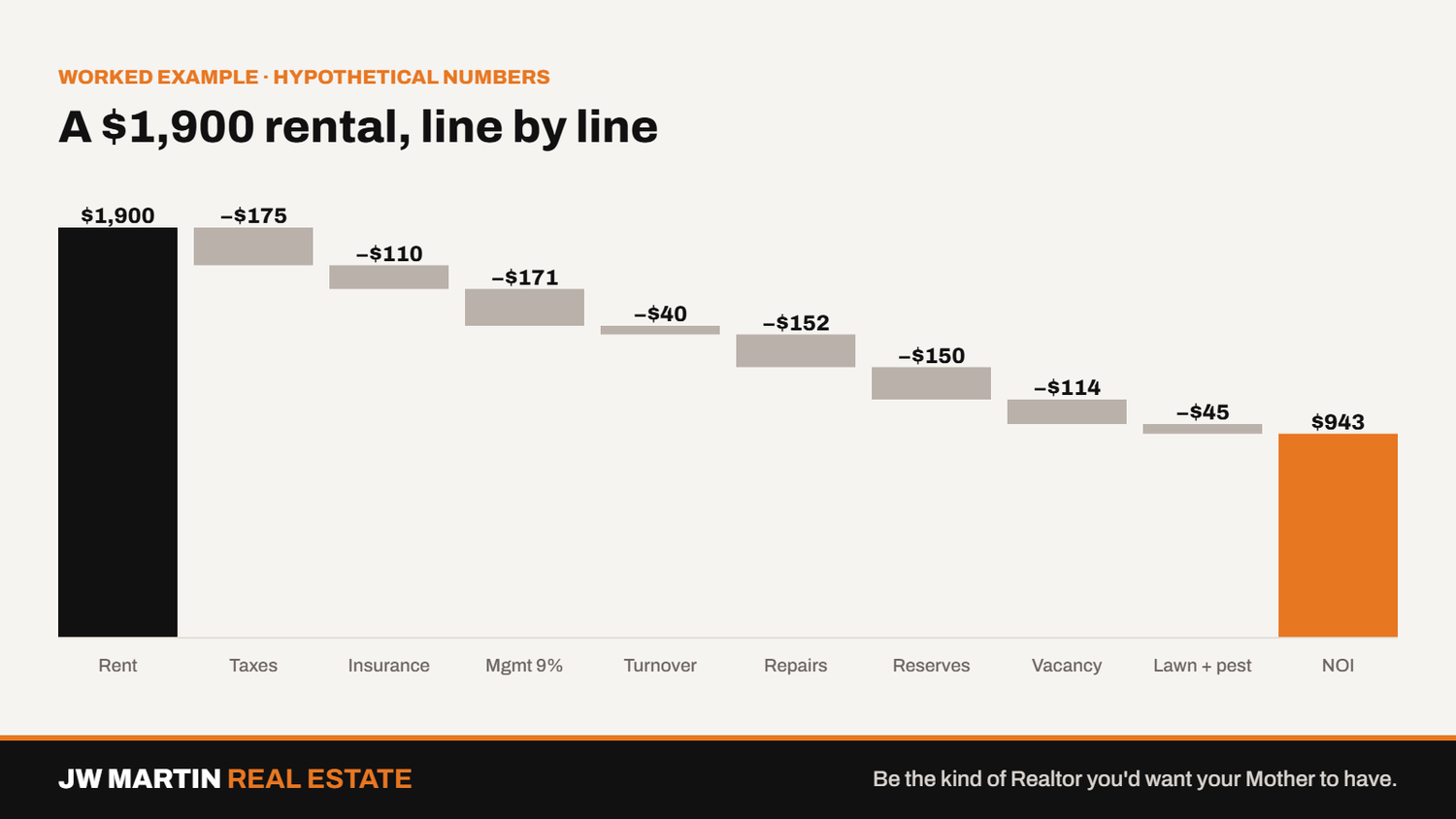
Here is the same $1,900-a-month rental with a line-by-line estimate. These are hypothetical figures for a 20-year-old single-family home.
- Property taxes as a rental: $175
- Landlord insurance: $110
- Property management at 9%: $171
- Leasing and turnover costs, averaged: $40
- Repairs and maintenance at 8%: $152
- Capital reserves (roof, HVAC, appliances): $150
- Vacancy at 6%: $114
- Lawn care and pest control: $45
Total: $957 a month, or about 50% of rent.
In this case the rule was close. Change a few inputs, such as a $150 HOA fee, a waterfront insurance policy or an older roof, and expenses can climb to 55% or 60% quickly.
Hypothetical numbers for illustration.
Why investors use it
- Speed. You can estimate cash flow with just the rent and the loan payment.
- Built-in caution. New investors almost always underestimate expenses. The 50% rule forces a reality check.
- Easy comparisons. It lets you compare several properties the same way.
When the 50% rule is off
Real expenses can land well above or below 50%:
- Lower than 50%: newer homes, tenants paying all utilities, and low-tax areas.
- Higher than 50%: older homes, high HOA dues, high insurance (common near water), professional management plus leasing fees, and short-term rentals.
- South Carolina taxes: a primary residence is assessed at 4%, while a rental is assessed at 6%, and owner-occupied homes skip school operating millage that rentals pay. Taxes can jump when a house becomes a rental, so use the rental tax figure, not the seller's.
How the 50% rule fits different Upstate properties
- Newer homes in planned communities: often 40% to 45%, unless HOA dues are high.
- Older homes in established neighborhoods: often 50% or more because of repairs and capital items.
- Clemson student rentals: turnover, wear and summer vacancy can push expenses higher.
- Lake homes rented long term: insurance, dock upkeep and HOA dues can push expenses well past 50%.
- Short-term rentals: cleaning, supplies, platform fees, utilities and furnishing often take 55% or more of gross income. Use our short-term rental calculator instead.
How to replace the 50% rule with real numbers
- Get the actual tax estimate for a non-owner-occupied property.
- Get an insurance quote for a landlord policy.
- Check HOA dues and rental rules.
- Use 8% to 10% of rent for management if you will hire it (ask for exact quotes).
- Set aside maintenance and capital reserves based on the home's age and systems.
- Use realistic vacancy for the area.
Then check cash-on-cash return, cap rate and DSCR.
Common mistakes
- Including the mortgage in the 50%.
- Using the seller's owner-occupied tax bill.
- Skipping capital reserves because the roof "looks fine."
- Trusting 50% on an older property that needs more.
- Forgetting to budget your own time if you plan to self-manage.
Frequently asked questions
Does the 50% rule work for multifamily? It is a common starting point, but real expenses vary with utilities, management and building age.
Is 50% too conservative? Sometimes, for newer homes. But it is far safer to overestimate expenses than to be surprised.
Does the 50% rule work for short-term rentals? Not well. Short-term rentals carry cleaning, supplies, platform fees, utilities, furnishing and higher turnover that a regular lease does not. Many run well above 50%, so use a dedicated short-term rental analysis instead.
How does this connect to the 1% rule? Many investors use both: the 1% rule to screen rent-to-price, and the 50% rule to estimate expenses.
How JW Martin Real Estate helps you get the numbers right
JW Martin Real Estate is a locally owned, non-franchise brokerage, and we also run JW Martin Property Management. That gives our investors something most agents cannot offer: real expense and rent data from homes we lease and maintain in the Upstate.
Our team decisions have to pass the Mom Test: Is this a decision my Mother would be proud of? So when we help you run numbers on a rental, we use honest rents, the rental tax rate and realistic reserves, even when that makes a property look less exciting.
The bottom line
The 50% rule is a great early warning system. Use it to quickly spot rentals that will not cash flow, then do the real math before you write an offer.
Talk with an Upstate investment specialist
Want help estimating real expenses on a rental? Visit our Investor Resource Center, search properties, or call JW Martin Real Estate at (864) 722-5558. As we like to say, "Be the kind of Realtor you'd want your Mother to have."
This article is general education, not financial, tax or legal advice. Examples are hypothetical and returns are not guaranteed.