Short answer: The 1% rule says a rental property's monthly rent should be at least 1% of what you pay for it, including repairs. A $200,000 all-in property should rent for at least $2,000 a month. It is a quick screening test, not proof that a property is a good investment.
If you are just starting to look at rental properties, you will hear about the 1% rule fast. It is one of the most popular shortcuts in real estate investing because it lets you sort through dozens of listings in a few minutes. But like any shortcut, it can steer you wrong if you lean on it too hard.
At JW Martin Real Estate, we talk with investors every week who found a "1% deal" online and want to know if it is real. This guide walks through how the rule works, where it helps, where it misleads, and how we use it with our own clients across Upstate South Carolina.

The 1% rule formula
The math is simple:
Monthly rent ÷ (purchase price + repair costs) ≥ 1%
Or, flipped around:
Minimum monthly rent = (purchase price + repair costs) × 0.01
Always include repairs. A $170,000 house that needs $30,000 of work is really a $200,000 investment, so it needs about $2,000 a month in rent to pass. Many investors also add closing costs to the total, which makes the test a little stricter and a little more honest.
Three quick examples
These are hypothetical numbers to show the math, not current market data.
- Example 1: Passes. Price $150,000, repairs $10,000, rent $1,650. All-in cost is $160,000. 1% of that is $1,600. Rent of $1,650 is about 1.03%, so it passes.
- Example 2: Close. Price $230,000, no repairs, rent $1,950. 1% is $2,300. Rent is about 0.85%, so it does not pass, but it might still work with a bigger down payment or long-term appreciation.
- Example 3: Fails badly. Price $450,000, rent $2,600. 1% is $4,500. Rent is about 0.58%. Many lake-area and higher-end homes look like this. They can still be good investments for appreciation or as short-term rentals, but they rarely cash flow as traditional long-term rentals.
You can test your own numbers in our free 1% and 2% Rule calculator.
Why investors use the 1% rule
- Speed. You can scan a list of homes and quickly toss out the ones that will almost certainly lose money as rentals.
- A rough cash-flow signal. Properties at or above 1% usually have a better chance of covering the mortgage, taxes, insurance and repairs.
- A common language. Agents, lenders and other investors know what you mean when you say a property "hits 1%."
Why the 1% rule can mislead you
The 1% rule only looks at two numbers: price and rent. It ignores almost everything else that decides whether you actually make money:
- Property taxes. In South Carolina, a primary residence is assessed at 4% of its value, while a rental is assessed at 6%. Owner-occupied homes also skip school operating millage that rentals pay. Put together, the tax bill on a rental can be much higher than what the seller paid. Always check the actual tax estimate for a rental.
- Insurance. Landlord policies, and insurance near water, can cost far more than you expect.
- HOA dues. Common in lake and newer communities, and some HOAs limit or ban rentals.
- Your loan. Interest rate and down payment change your payment a lot.
- Condition. An older house that passes 1% may need a roof, HVAC or septic work soon.
- Vacancy and turnover. Cheaper rentals often have more turnover and higher repair costs.
That is why a property that passes the 1% rule can still lose money, and a property that misses it can still be a solid long-term investment.
Running the 1% rule on a real-world style listing
Here is how we walk a client through a typical Upstate rental. These numbers are hypothetical but realistic in shape.
- List price: $210,000 for a 3-bedroom ranch near Seneca.
- Repairs: paint, flooring and a water heater, about $9,000.
- Closing costs: about $5,000.
- All-in cost: $224,000. The 1% target is $2,240 a month.
- Market rent: comparable leased homes nearby rent for $1,800 to $1,900.
- Result: about 0.83%. It fails the 1% rule.
Most online screeners would stop here. We keep going, because the next question is what the investor is trying to do. With 25% down, a landlord insurance quote, the rental tax estimate and 8% management, this house might break even or make a little each month. For an investor who wants long-term appreciation near Lake Keowee and Clemson, that may be fine. For an investor who needs $300 a month of cash flow today, it is a pass.
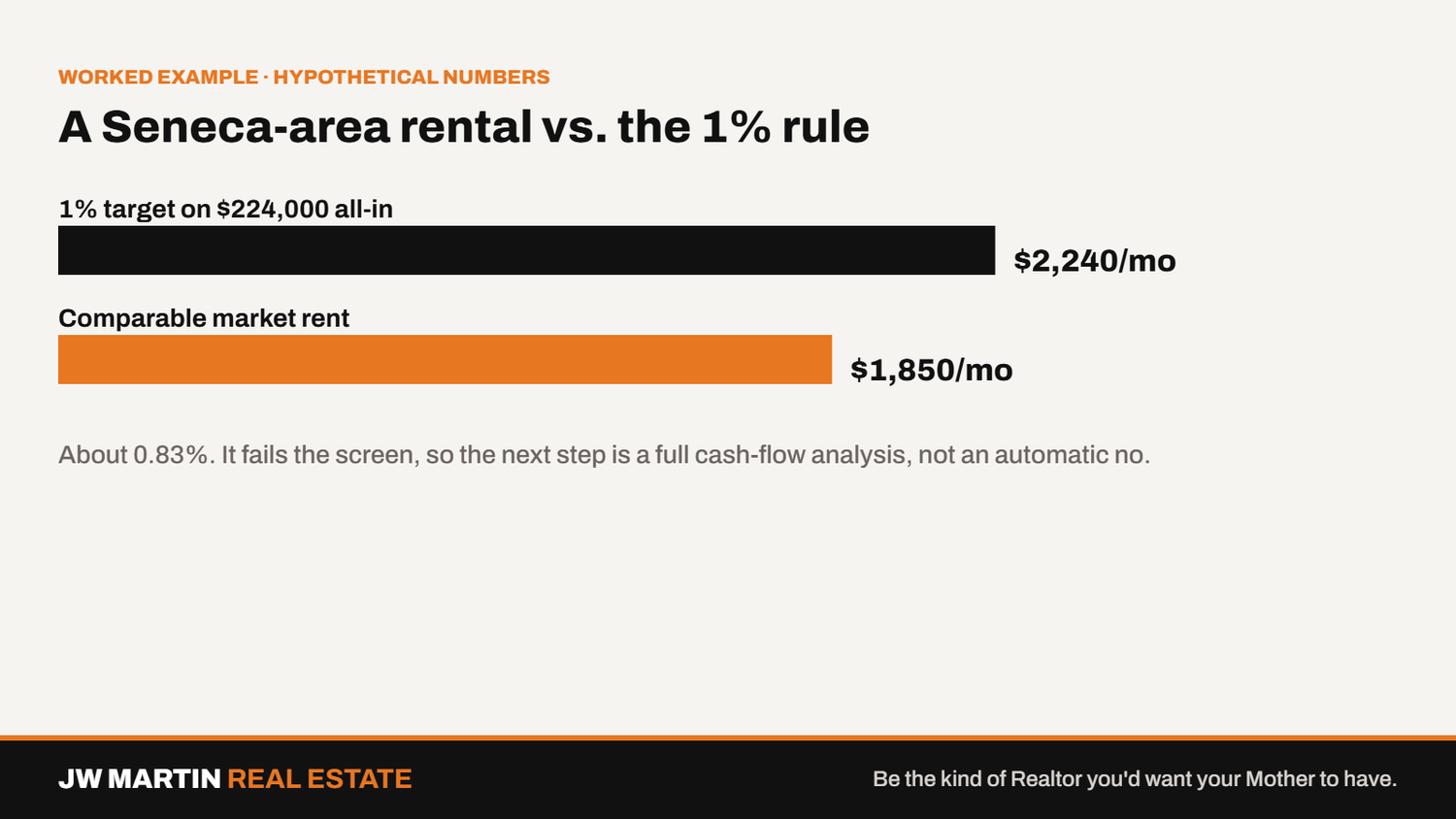
Hypothetical numbers for illustration.
Is the 1% rule still realistic in Upstate South Carolina?
In many parts of the Upstate, especially near Lake Keowee, Lake Hartwell, Clemson and Greenville, home prices have risen faster than rents, so fewer properties hit 1%. Here is how it tends to break down by property type:
- Lake and waterfront homes: almost never hit 1% as long-term rentals. Investors buy them for appreciation, personal use or short-term rental income.
- Clemson-area rentals: student demand is steady, but prices reflect it. Rent-by-the-bedroom setups can push closer to 1%, with more management work and more wear.
- Small multifamily (duplexes to fourplexes): often your best shot at 1% in the Upstate, though good ones go fast.
- Older homes in smaller towns: more likely to pass on paper. Inspect carefully, because repairs decide whether they work.
- New construction: usually well below 1%, with lower repair costs in the early years.
Many investors here buy below 1% on purpose. They are betting on long-term appreciation, loan paydown and steady demand from Clemson University, local employers and people moving to the area. That can work, but only if the full cash-flow numbers work too.
How to use the 1% rule the right way
- Use it as a first filter only. Pass or fail, the next step is always a full cash-flow analysis.
- Use real market rent. Base it on comparable rentals, not the highest listing you can find.
- Include all-in cost. Price plus repairs plus closing costs.
- Run the real numbers. Plug taxes, insurance, HOA, management, maintenance, vacancy and capital reserves into our rental cash-flow calculator.
- Check the 50% rule and cash-on-cash return. See our guides to the 50% rule and cash-on-cash return.
Common mistakes
- Treating "passes 1%" as "good deal."
- Forgetting repairs and closing costs.
- Using a hoped-for rent instead of proven market rent.
- Ignoring South Carolina's higher tax on rental property.
- Walking away from solid long-term properties just because they miss 1%.
Frequently asked questions
Is the 1% rule the same as the 100× rent rule? Yes, they are two ways of saying the same thing. If the price is no more than 100 times the monthly rent, it meets 1%.
Does the 1% rule work for short-term rentals? Not really. Short-term rental income changes by season and needs its own analysis based on realistic yearly averages, cleaning, furnishing and management costs. Try our short-term rental calculator.
What if a property is at 0.8%? Run the full numbers. With a larger down payment, lower expenses or strong appreciation potential, it may still meet your goals.
Is the 2% rule better? It is stricter, not better. Read The 2% Rule Explained.
How JW Martin Real Estate helps investors
JW Martin Real Estate is a locally owned, independent brokerage. We are not a franchise, and we live in the same Upstate communities where our clients invest. That means we know which neighborhoods have HOA rental limits, where student demand is strongest, and which "great deals" have problems you cannot see in the listing photos.
Every recommendation we make has to pass what we call the Mom Test: Is this a decision my Mother would be proud of? For investors, that means we will tell you when a property does not pencil out, even if it means we do not write an offer that week.
When you work with us, we can:
- Pull rental comps so your rent number is real.
- Get a rental tax estimate before you make an offer.
- Connect you with local lenders, inspectors and contractors.
- Lease and manage the property through JW Martin Property Management.
The bottom line
The 1% rule is a helpful flashlight, not a map. Use it to spot properties worth a closer look, then do the real math before you make an offer.
Want help finding rentals that make sense in the Upstate? Visit our Investor Resource Center, search properties, or call JW Martin Real Estate at (864) 722-5558. As we like to say, "Be the kind of Realtor you'd want your Mother to have."
This article is general education, not financial, tax or legal advice. Examples are hypothetical and returns are not guaranteed.