Short answer: The 2% rule says a rental's monthly rent should be at least 2% of its all-in cost. A $100,000 property would need $2,000 a month in rent. Properties that truly meet it are rare today, and the ones that do often carry higher risk, so treat 2% as a red flag to investigate, not an automatic yes.
Every so often an investor calls our office excited about a property that "hits 2%." Sometimes it is a genuine opportunity. More often, the rent is optimistic, the repairs are bigger than they look, or the location brings turnover that eats the profit. This guide from JW Martin Real Estate explains the rule, why it became popular, and how to check whether a 2% deal is really a deal.
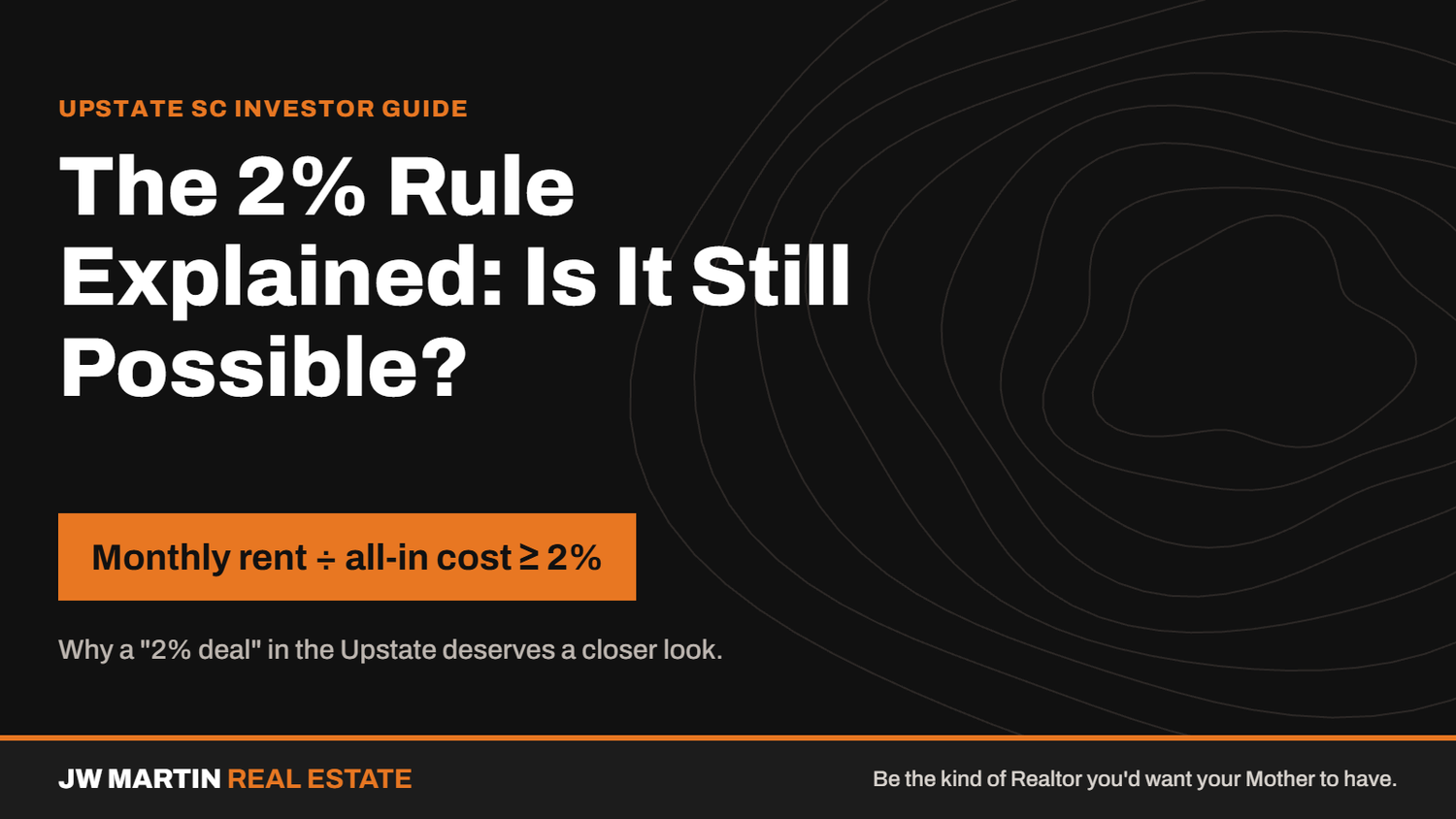
The 2% rule formula
Monthly rent ÷ (purchase price + repairs) ≥ 2%
Minimum rent = (purchase price + repairs) × 0.02
It is the same idea as the 1% rule, just twice as strict. Another way to say it: the price should be no more than 50 times the monthly rent.
Examples (hypothetical)
- $80,000 all-in, rent $1,600: exactly 2%. Passes.
- $120,000 all-in, rent $1,700: about 1.4%. Fails 2% but passes 1%.
- $250,000 all-in, rent $2,200: about 0.9%. Fails both.
Try your own numbers in the 1% and 2% Rule calculator.
Why anyone uses the 2% rule
The 2% rule became popular when lower-priced houses could be bought cheaply and rented for strong cash flow. Investors used it to find properties that would almost certainly cash flow even with high expenses. In some markets and price ranges, it can still surface unusually strong rent-to-price deals.
The logic is simple. If rent is that high compared to price, there should be plenty of room to pay the mortgage, taxes, insurance and repairs and still have money left over. The problem is that the rule assumes expenses stay "normal." On the kinds of properties that hit 2%, they often do not.
Is the 2% rule still possible?
In most of Upstate South Carolina, true 2% properties are uncommon. Home prices have climbed faster than rents in many areas. When you do find one, ask why:
- Condition. Is it cheap because it needs a roof, HVAC, plumbing, electrical or septic work?
- Location. Are there higher vacancy rates, more turnover or more evictions in the area?
- Hidden costs. Older homes often have higher insurance and maintenance.
- Rent reality. Is the rent you are using actually achievable, or is it the highest number on a rental site?
- Title and legal issues. Very low prices sometimes come with liens, heirs' property questions or code violations.
A property can pass 2% on paper and still lose money once you pay for repairs, vacancy and management.
What a 2% deal looks like after real expenses
Here is a hypothetical example of how a 2% property can shrink once you add real costs.
- All-in cost: $90,000
- Rent: $1,800 a month (2%)
- Vacancy and turnover at 10%: −$180
- Repairs and maintenance on an older home at 15%: −$270
- Capital reserves (roof, HVAC, water heater): −$150
- Management at 10%: −$180
- Taxes and landlord insurance: −$250
- Mortgage on a $67,500 loan at 7.5%: about −$472
Estimated cash flow: about $298 a month, before any big surprise. That is still positive, but it is a long way from the $1,000-plus a month the headline ratio suggests. And if one tenant stops paying or the HVAC fails, a full year of profit can disappear.
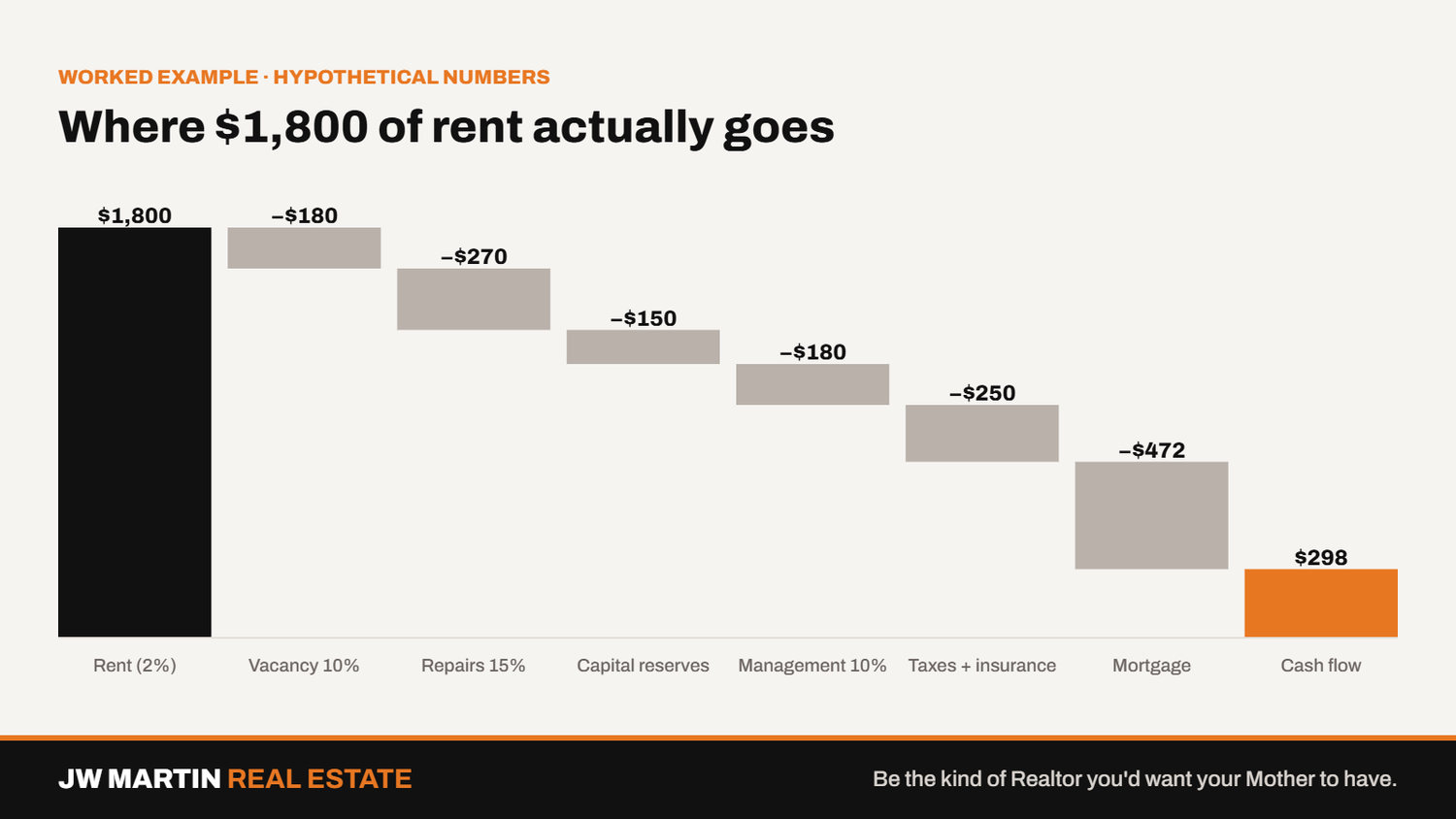
Hypothetical numbers for illustration.
The 2% rule vs. the 1% rule
- 1% rule: a realistic screening bar for many single-family and small multifamily rentals.
- 2% rule: a very high bar that mostly shows up with lower-priced or distressed properties.
- Both: ignore taxes, insurance, HOA dues, financing and appreciation.
Neither is underwriting. The real test is cash flow after every expense.
How to evaluate a "2% deal"
- Get a real repair estimate before you trust the all-in cost.
- Verify rent with comparable leased rentals, not asking rents.
- Use conservative vacancy and maintenance, often higher for older properties.
- Check the tax bill as a rental. In South Carolina, rentals are assessed at 6% instead of the 4% primary-residence rate.
- Run the full numbers in our rental cash-flow calculator: NOI, cash flow, cash-on-cash return, DSCR and break-even occupancy.
- Plan management. Many 2% properties need hands-on or professional management to perform.
Common mistakes
- Assuming high rent-to-price means high profit.
- Underestimating repairs and turnover costs.
- Skipping inspections because "the numbers are so good."
- Comparing a 2% property to a 0.8% property without considering appreciation and risk.
- Forgetting that time spent dealing with problem properties has a cost too.
Frequently asked questions
Is the 2% rule better than the 1% rule? It is stricter, not better. Many great long-term rentals never come close to 2%.
Can new construction meet the 2% rule? Very rarely. New homes usually trade lower cash flow for lower repair costs and stronger appreciation potential.
Should I skip everything under 2%? No. Use the full cash-flow numbers and your goals, whether that is cash flow, appreciation or both.
Where are 2% properties most likely in the Upstate? Usually in lower-priced homes in smaller towns, or properties that need major work. Those can be good buys for experienced investors with a contractor team, but they are rarely hands-off.
How JW Martin Real Estate approaches "too good to be true" deals
JW Martin Real Estate is a locally owned, non-franchise brokerage, and our team lives and works in the Upstate. We know the streets, the school zones and the neighborhoods where rent numbers hold up, and the ones where they do not.
Our team decisions have to pass the Mom Test: Is this a decision my Mother would be proud of? With a 2% property, that means we will help you look under the hood before you buy. We will pull leased rent comps, help you get a rental tax estimate, and point out the risks we see. If it still makes sense, we will help you buy it and can manage it through JW Martin Property Management.
The bottom line
The 2% rule is a fun target, but today it is more likely to point you toward a risky property than a hidden gem. Use it to ask good questions, then let the real numbers decide.
Talk with an Upstate investment specialist
Looking for rentals with real cash flow, not just a pretty ratio? Visit our Investor Resource Center, search properties, or call JW Martin Real Estate at (864) 722-5558. As we like to say, "Be the kind of Realtor you'd want your Mother to have."
This article is general education, not financial, tax or legal advice. Examples are hypothetical and returns are not guaranteed.